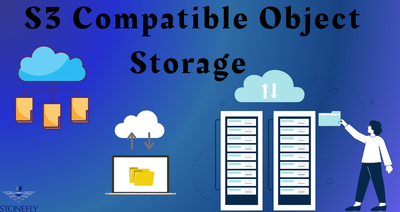
Businesses are struggling under the weight of their own data. The explosion of unstructured content—from high-definition video and medical images to sensor logs and vast backup archives—is pushing traditional file-based storage systems to their breaking point. These rigid, hierarchical systems were never designed for the petabyte scale, leading to performance bottlenecks and management nightmares. In response, a more agile and scalable architecture has become the new standard: object storage. The widespread adoption of S3 Compatible Object Storage allows organizations to manage massive datasets with unprecedented flexibility, creating a common language for applications to interact with data, regardless of where it lives.
This approach untethers software from specific hardware, empowering developers and IT teams to build modern, resilient, and future-proof data ecosystems. This article will break down what it means for storage to be "S3 compatible," explore the immense benefits this brings, and show how it is being used to solve some of the most pressing data challenges today.
To grasp the significance of this technology, it's helpful to contrast it with the storage models we use every day.
Traditional storage systems organize data into files and folders. This works well for personal documents but becomes incredibly complex at scale. Every file's location is defined by a rigid path (e.g., C:\Work\Projects\Archive\file.docx), and managing millions of these paths is a heavy burden on the system.
Object storage flattens this structure. Data is stored as a self-contained "object" that includes three components:
This model is infinitely more scalable because there is no complex directory to maintain. You can have billions of objects in a single "bucket" (a container for objects) without a drop in performance.
The "S3 compatible" part refers to the Application Programming Interface (API) the storage uses. An API is a set of rules that lets software programs talk to each other. The S3 API has become the undisputed industry standard for object storage.
When a storage platform—whether it's a hardware appliance in your data center or a software-defined solution—is S3 compatible, it means it fluently speaks this universal language. Your backup software, video editing suite, or analytics platform can use the same PUT, GET, and DELETE commands to store and retrieve data, regardless of the underlying storage vendor.
Adopting a common API for storage is not just a technical detail; it is a strategic business decision that unlocks flexibility, prevents vendor lock-in, and empowers innovation.
Imagine if every car brand used a different type of steering wheel, pedals, and gear shift. It would be a nightmare. The S3 API acts as a standard, ensuring that your applications are not "locked in" to a single storage provider. You can develop an application using an on-premise object storage system and later migrate that workload to a different vendor's platform with minimal code changes. This freedom to choose the best storage for the job—based on cost, performance, or features—is a powerful advantage.
For developers, a standardized API dramatically simplifies building applications that handle large amounts of data. They don't need to learn a new, proprietary storage protocol for every project. They can use widely available S3 Software Development Kits (SDKs) and tools, accelerating development cycles and reducing bugs. This allows them to focus on building features for the application, not on wrestling with storage integration.
One of the most transformative features of object storage is its use of rich metadata. With a file system, you can only know basic information like the file name and creation date. With an object, you can attach any information you want. A medical image could be tagged with the patient ID, study date, and modality (X-ray, MRI).
This turns your storage into a searchable, intelligent database. You can build automated workflows based on these tags, such as:
The use cases for S3 Compatible Object Storage span nearly every industry, serving as the backbone for modern data-intensive workloads.
Ransomware has become one of the biggest threats to business continuity. Attackers no longer just encrypt data; they actively hunt for and delete backups to force a ransom payment. S3-compatible systems offer a powerful defense called "Object Lock" or immutability. This feature allows you to mark objects as unchangeable and undeletable for a specified time.
When your backup software writes to an immutable bucket, it creates a tamper-proof copy of your data. Even if an attacker gains full administrative control, they cannot overwrite or erase the protected backups. This guarantees you have a clean copy of your data for recovery.
The media industry deals with massive files. Storing and distributing terabytes of video content requires a highly scalable and accessible storage platform. Object storage is a perfect fit. Broadcasters and streaming services use it to host vast libraries of content that can be served directly to web and mobile applications via API calls. Production houses build private clouds on S3-compatible platforms to give editors fast, local access to raw footage.
A data lake is a central repository where an organization stores all its structured and unstructured data at any scale. Object storage is the ideal foundation for data lakes because of its cost-effectiveness and limitless scalability. Analytics engines and machine learning platforms can connect directly to these S3-compatible endpoints to process massive datasets for business intelligence, predictive modeling, and AI training.
The way we manage data is undergoing a fundamental shift. The old model of rigid file hierarchies is giving way to the flexible, scalable, and intelligent world of object storage. By standardizing on a common protocol, S3 Compatible Object Storage provides a universal bridge between applications and data, breaking down silos and eliminating vendor lock-in.
This technology empowers organizations to build agile, cost-effective, and resilient data infrastructures that can handle the demands of today and the exponential growth of tomorrow. Whether you are aiming to secure your backups, streamline media workflows, or unlock insights from your data lake, embracing this API-driven approach is a crucial step toward modernizing your data strategy.
S3 is a protocol, which is a set of communication rules that software follows. It defines how applications should request to store, retrieve, or delete data. "S3 compatible" means a storage product (which could be hardware or software) is designed to understand and respond to these rules.
No. Object storage is not block storage, so you cannot install an operating system on it or run a database directly from it. It is accessed over a network by applications that are specifically designed to communicate using the S3 API. It serves as a separate storage tier, not as a primary system disk.
Unstructured data is information that doesn't fit neatly into a traditional database row or column. This includes things like emails, videos, images, audio files, social media posts, and log files. Object storage is ideal for this type of data because it can store the file in its native format.
The S3 protocol has robust, built-in security features. This includes strong encryption for data both in transit (over the network) and at rest (on the disk). It also features granular Identity and Access Management (IAM) controls, allowing you to define precisely which users or applications can perform which actions on specific data buckets.
A folder creates a nested, hierarchical path to a file. A bucket is a top-level container for objects in a flat namespace. While you can use prefixes in object names to simulate a folder structure for organizational purposes (e.g., backups/server1/file.zip), the system itself sees a flat list of objects. This simplicity is what allows it to scale so effectively.